Made in Mexico in 1950 by the great surrealist filmmaker Luis Buñuel, this is still the hardest hitting movie about youth forged through violence and poverty. Los Olvidados is the film City of God could have been back in 2002, had a priority been placed on substance over style. In fact, many movies have plumbed this subject matter in the last sixty years, trying to do Buñuel one better, but none have succeeded thus far. The fourth season of The Wire brilliantly tackled similar material, it should be required viewing for all adults, but there were twelve hours to tell that story while Los Olvidados got it done in eighty minutes.
When I called this movie hard hitting, I wasn't kidding. Upon release it lasted only two days in theaters before being banned. There were some who wanted Luis Buñuel deported. The authorities were concerned that the movie made Mexico City look like a terrible place to live. In truth, this story is universal. There are kids growing up in these situations in every culture and big city of the world, whether it's Dallas or Los Angeles, Brussels or Beijing.
Inspired by Shoeshine, Vittorio De Sica's 1946 neorealist film, Buñuel took to the streets in ragged clothes to research his subject firsthand (Sullivan's Travels anyone?). He was relatively new to Mexico, being born in Spain and having directed his earliest pictures in France (1929's Un Chien Andalou and 1930's L'Age D'or). After meeting real children living like the ones we see in his film, Bunuel knew more of Mexico City's dark underbelly than did most of its middle to upper class citizens. Even better, despite a low budget and a miniscule three week shooting schedule, he was determined to expose it.
This isn't really a “message movie” though. Buñuel offers no solutions. He paints a very bleak portrait, and doesn't pretend anything will be done about it. Nothing has, after all, and perhaps nothing will. Even worse, perhaps nothing can. I guess this is why I remain doubtful when a politician comes up with a “solution” to a problem. There are no new problems. The fundamentals have not changed in decades, perhaps centuries. When I read Dostoyevsky, for example, I'm always shocked at how little has changed in this world over the last century and a half. People have invented solutions to the very same problems for time immemorial, and yet, the problems are still here. So what good were these “solutions”? Then again, what does it say about us if we don't try? If the illusion of progress disappeared, what then? It would be like giving up.
Buñuel was wise to focus on children here. We expect an adult to be responsible, which makes them easier to judge. If a man's family is starving, we say he needs to get a job. If his teenager is causing problems, it is his responsibility to rectify the issue. Simple enough, we would like to think. But what of the children born into homes where this doesn't happen, for whatever reason, and those reasons are beyond the child's control?
What of the youngsters like Jaibo (Roberto Cobo), the villain of this piece if there is one, who never knew his parents and grew up on the streets. He beats and robs the blind and handicapped because it's what he knows. Living like a stray dog in the slums, he learned to survive as an animal would; treating his environment as a jungle and its people as his prey. He's a predator, and the movie treats him as such, but did he have another option? The main character, a boy named Pedro (Alfonso Mejía), wants to be a good kid but falls in with the wrong crowd. His young mother resents him each day for being the living, constant reminder of a rape she suffered at age fourteen. Another boy, Ojitos (Mário Ramírez), is told to wait for his father's return at the marketplace, but his father never comes back. Alone and afraid, the boy is taken in by a “generous” man, who turns out to be a pedophile.
The actual title of this movie is “The Forgotten Ones”, and that's what these kids are. Forgotten by family, forgotten by society, left to roam aimlessly, defining survival as the acquirement of food or money through bloodshed. The ones who live long enough to reach puberty will likely be tomorrow's rapists, and barring abortion, we end up with another unwanted child like Pedro.
Those familiar with Buñuel's surrealist pictures, including The Exterminating Angel, The Discreet Charm of the Bourgeoisie, and the two I mentioned earlier, may be surprised by his technique here. It's as if he took the Italian neorealist style of De Sica and Rossellini, and gave it a surrealist flourish. For the most part we see honest, painful realism, but then Buñuel springs a dream sequence on us that would feel right at home in even his strangest film. Pedro's dream amplifies the themes of the picture with bizarre sounds and imagery; chicken feathers fall like snow, Pedro's mother seems to walk on air before offering him a huge slab of raw beef, intercepted in desperation by the monster under his bed, Jaibo.
Los Olvidados is a tough movie, but also a great one. It shows us that certain social problems have no boundaries in the form of time or culture; they remain persistent and universal. It reveals the vicious cycle of poverty; laying bare the way violence begets violence. In one shot, deep in the distance, we see a busy highway. From the slums, this bridge and everything it represents (progress, civility, balance, order) appears to be light years away, like another world. Society's reaction is to make sure these people remain on the fringe of civilization, like a colony of lepers, neither seen nor spoken of. Again, forgotten.
This brings me to another issue I have with City of God. In that film, our “hero” is just as poor as the other kids, and equally inundated with violence. Somehow, he resists. Instead of taking an active part in gang violence, he starts taking photographs of the slum wars in Rio. He sends these pictures into the newspaper, becomes a famous photographer, and lives happily ever after. He's the anomaly, the exception. The one who got out. By making him the centerpiece of the story, we turn all this madness and destruction into a story of inspiration. We see him and think he's proving everyone wrong, like Rocky Balboa. The underdog wins (or the “slumdog” in Danny Boyle's Slumdog Millionaire), and of course, “if he can do it, anyone can!” The only problem is, most of them can't. Most of them never escape. So in the process of patting one boy on the back and leaving the theater with smiles on our faces, we make it easier to ignore the millions of kids still trapped in an endless cycle.
Monday, January 23, 2012
Tuesday, January 17, 2012
The Silent Treatment
My very first post in this blog back in 2008 (“WALL-E: The Return of Visual Storytelling”) was about visuals taking a backseat to dialogue in cinema. This is not always the case, but so often it is, many have lost their ability to read images. WALL-E, inspired by the great silent comics, may have been low on dialogue, but it was loaded with visual invention. The images told the story. Furthermore, WALL-E was a satire about where our world is headed; remember the overweight people zipping around on comfy electronic chairs, sucking nutrients through straws as they watched futuristic televisions? Technology had reached a point where humans were no longer required to act, so they became passive.
That is precisely what the majority of television shows and movies have done to the masses. We have gotten used to being babied, spoon-fed everything through expository dialogue. Viewers are content to be passive, as only rarely are they asked to exercise their brain at the theater. I am reminded of the captain in WALL-E who struggled to walk; his legs were like jelly because he had never put them to use! So when a film comes along demanding an active viewer, requiring those brain cells to kick-start and get moving, scores of people inevitably dismiss it off-hand. It has become a burden to think at the movies. After all, it is much easier to line the coffers of Michael Bay (Bad Boys, Armageddon, Transformers, etc.), whose entire reputation depends on an audience averse to intelligent thought.
The visual language of film may have been developed during the silent era, when images were the language, but the two were never mutually exclusive. Sound was not intended to be the death knell of visual storytelling; film is an inherently visual medium, after all. Screenwriters used to live by the rule, “Never say it if you can show it.” The first five minutes of the 1954 Alfred Hitchcock film, Rear Window, offer a textbook example of how it should be done.
The camera pans across an apartment courtyard, giving us a voyeuristic peek at various characters going about their business; a man shaving, a sexy woman dancing, kids playing in water across the street, etc. Eventually, we pull back to see James Stewart at rest in his apartment, sweat beading up on his forehead. It's a hot day. The camera continues downward, revealing his leg in a cast. We see a busted camera on a nearby table, and several pictures of a car crash at a big race. In one of them, the airborne car seems to be coming directly at the cameraman. Another frame holds a negative print of a woman, Grace Kelly, while the positive print adorns a fashion magazine cover nearby.
Not a single word is spoken in that first five minutes (save for a brief radio advertisement), yet we are told so much. We know the heat is stifling, we know Stewart is a photographer who was injured at a race, we know his wife or girlfriend works for a fashion magazine, and we have been well acclimated to the voyeur's role we will assume for much of the film. For a more recent example of perfect visual storytelling, look no further than this four-and-a-half minute montage in Pixar's 2009 film, Up. Filled with character and raw emotion, despite lacking one word of dialogue or a single sound effect, Pixar could make an amazing silent film were they so inclined.
With the power to reveal so much, it's a shame when an image reveals so little. There was a time when the positioning of characters within the frame would indicate almost everything about their relationship. There was a time when a character's mood would be subtly reflected in the way shadows fell across the screen, a time when changes in the weather foretold something ominous, joyous, or anything in-between. When people watched Citizen Kane they understood the symbolism of the massive windows when Orson Welles walked deep into the frame; he was losing his vast media empire and felt as miniscule as those windows suddenly made him look (see above). Audiences knew when a character felt lost or isolated in their life, they knew when a marriage was falling apart. They understood that a shot of a train entering a dark tunnel, moments after a couple's passionate embrace, meant penetration of another sort was going on.
Despite the current state of mainstream filmmaking, there are always a handful of movies a year determined to buck the trend. In 2011 we got several, including Terrence Malick's The Tree of Life, Lars von Trier's Melancholia, etc. Two films, in particular, were crafted as “love letters” to the innovative magic of early, visual cinema. Like WALL-E, Michel Hazanavicius' The Artist and Martin Scorsese's Hugo are absolutely indebted to and passionate about silent film.
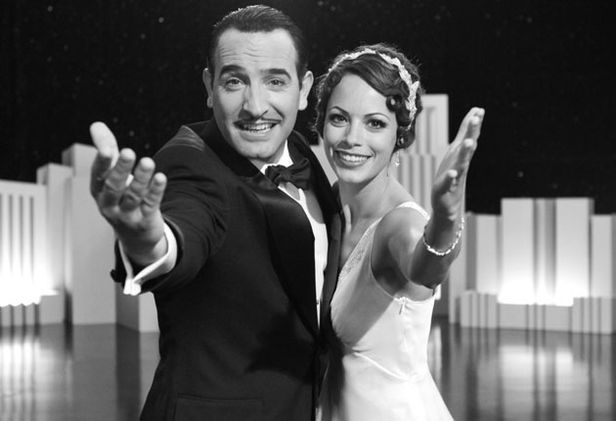
The Artist is a silent film, in fact, with an original musical score by Ludovic Bource (the 2012 Golden Globe winner for Best Score). Hazanavicius went all out with his homage, filming in black-and-white, 22 frames-per-second, and the 1.33:1 aspect ratio (a frame only slightly wider than it is tall). He cheats a bit, playing the song “Pennies From Heaven” over a montage and including two other instances of sound. Still, for all intents and purposes, this is a brand spankin' new silent picture.
The use of Bernard Herrmann's iconic 1958 Vertigo score has proven much more stupefying than any intrusion of speech or sound effects. Hitchcock fans will notice immediately, but I strongly disagree with Kim Novak's argument. The rest of The Artist is clear evidence, Hazanavicius simply adores the classics. The Vertigo music was a temporary track, which ultimately could not be improved upon for the scene. There is no cause for alarm, The Artist will not replace Vertigo in anyone's memory. Herrmann's music is still about the love and obsession Scotty Ferguson feels for Madeleine Elster.
The Artist begins in 1927, an amazing year for silent pictures (Sunrise, Metropolis, The Unknown, Seventh Heaven, Wings, etc.), and for the world's first sound film, The Jazz Singer. We meet George Valentin (Jean Dujardin), a silent star in the mold of Douglas Fairbanks and Rudolph Valentino, as he attends the Hollywood premiere of A Russian Affair, the latest in his seemingly endless string of box office hits. Afterward, a lively aspiring actress in the crowd, Peppy Miller (Bérénice Bejo), stumbles into Valentin for a “meet cute” and the press eats it up.
Valentin runs into Peppy again when she comes to the studio for an audition, and convinces his boss (John Goodman) to give her a small role in their new movie. Unfortunately, sound features are all the rage, and Valentin refuses to change with the times. Instead, he goes independent, sinking his own fortune into a new silent film. From here we get echoes of Singin' in the Rain (1952) and A Star is Born (1937, 1954, 1976, take your pick), with Peppy rising fast as Valentin takes a fall.
The Artist is filled with lovely moments, including a nod to Citizen Kane's justly famous breakfast table montage. Peppy has an adorable scene with Valentin's coat, and the dog is just adorable, period. Valentin's nightmare is inventive and humorous, as the simplest of sounds are magnified, causing him to scream in terror. At one point, Valentin passes Peppy on a flight of stairs. It's almost a throw-away moment, but those who take notice of the scene's dynamics will receive a simple, visual reinforcement of the film's theme. The final line of the movie is a nice touch, succinctly explaining Valentin's reluctance to make sound films, but then again, it makes me wonder if Maurice Chevalier existed in this version of Hollywood.
There are those who have criticized Hazanavicius for making a silent, they like to cry “gimmick”. Others accuse The Artist of being a poor substitute for the films it imitates. The gimmick claim is bogus; silent films are a unique medium, in my opinion. What's wrong with using a vastly different method to tell a story? In a perfect world I believe we would still have silents and more black-and-white films being produced, along with the latest blockbusters. I concede, however, that I would take dozens of old silent films over The Artist. In no way does that comment berate Hazanavicius' film, it simply reflects the incredible quality of the real deal.
Still, when I walked out of The Artist I felt reinvigorated. It was a packed house, yet a pin could be heard dropping in there. The audience was enraptured by the film, bursting into applause at the end. By virtue of being new and shiny (winning the Golden Globe for Best Picture and Best Actor won't hurt), The Artist has successfully drawn crowds to what is essentially a nostalgia piece. Hopefully, those in attendance have been inundated by one thought: “Hey, these silent films are pretty damn good!” If The Artist inspires just a few people to look back at the classics with an open mind and newfound respect, its duty would be done. Something tells me it will be more than “a few”.
Filled with all the latest tools of the trade (slick 3D, seamless computer animation, etc.), Hugo takes an entirely different road to reach the same destination. It celebrates one man in particular; the great cinematic pioneer, Georges Méliès. Based on Brian Selznick's book, The Invention of Hugo Cabret, the story takes place in and around a Parisian train station in 1931. A young orphan, Hugo Cabret (Asa Butterfield), operates the station clocks as his drunken uncle had done. He is regularly on the run from the station inspector (Sacha Baron Cohen), and occasionally steals a few items from a toy maker who happens to be Méliès (Ben Kingsley). Hugo needs these mechanisms to repair an automaton his father (Jude Law) had been working on before he passed. He believes a hidden message has been left within.
SPOILER ALERT: The big mystery that Hugo and his friend Isabelle (Chloë Grace Moretz) solve is that of Méliès' hidden past. It is historically accurate that once Méliès' star faded, the French army took about four hundred of his original film prints and melted them down to create boot heels. Méliès also burned a bunch of the negatives in a rage, believing them worthless. In his later years he ran a toy shop in the Montparnasse train station, where we meet him in Scorsese's film. The children discover all of these secrets and come across a man whose greatest inspiration is Méliès. Together they convince Méliès that his work was vital and glorious. The entire film, and it's a very good one, boils down to the healing of one man's heart.
Film fans will love the recreation of Méliès studio, made of glass so the sets could be properly lit. There are those of us who will instantly recognize the films being made there, including Kingdom of the Fairies from 1903. What a great touch it was, seeing the primitive camera filming an underwater scene through an aquarium, with lobsters being dropped in the foreground. It's a simple illusion, but at a time when the medium was so young, it seems positively ingenious. Méliès was a magician prior to making films, and his pictures are like little miracles. Narratively, they are not on the level of later silent films, but if any one man invented the language of cinema before D.W. Griffith, it was Méliès.
After watching Hugo, I hoped to see a renewed interest in Méliès', and my wish came true! For a few weeks following Hugo's release, this DVD set of his films was sold out everywhere. The company responsible for the DVDs had to issue an apology, they simply were not prepared for the sudden increase in demand. I imagine that, for Martin Scorsese, this reward tasted even sweeter than his Golden Globe for Best Director.
Both The Artist and Hugo are incredibly refreshing in this day and age. They are distinctly visual films that go well beyond the superficial, special effects-laden definition of “visual”. They are family friendly (the undeserved PG-13 rating for The Artist shows the absurdity of the MPAA). One is a French film, the other takes place in France. Each has a strong admiration for silent cinema, and indeed all cinema.
Generally I'm not big on 3D (now there is a gimmick), but I must say Scorsese and his cinematographer, Robert Richardson, get it right. There was magic in the air when Scorsese gave us the moon. For one hundred and ten years the “face of the moon” in Méliès Voyage to the Moon, one of the most iconic images in film history, has been locked away in two dimensions. For one brief, exhilarating moment that very moon breaks free of the screen. Right then, the smile on my face could probably be seen from the moon too.
That is precisely what the majority of television shows and movies have done to the masses. We have gotten used to being babied, spoon-fed everything through expository dialogue. Viewers are content to be passive, as only rarely are they asked to exercise their brain at the theater. I am reminded of the captain in WALL-E who struggled to walk; his legs were like jelly because he had never put them to use! So when a film comes along demanding an active viewer, requiring those brain cells to kick-start and get moving, scores of people inevitably dismiss it off-hand. It has become a burden to think at the movies. After all, it is much easier to line the coffers of Michael Bay (Bad Boys, Armageddon, Transformers, etc.), whose entire reputation depends on an audience averse to intelligent thought.
The visual language of film may have been developed during the silent era, when images were the language, but the two were never mutually exclusive. Sound was not intended to be the death knell of visual storytelling; film is an inherently visual medium, after all. Screenwriters used to live by the rule, “Never say it if you can show it.” The first five minutes of the 1954 Alfred Hitchcock film, Rear Window, offer a textbook example of how it should be done.
The camera pans across an apartment courtyard, giving us a voyeuristic peek at various characters going about their business; a man shaving, a sexy woman dancing, kids playing in water across the street, etc. Eventually, we pull back to see James Stewart at rest in his apartment, sweat beading up on his forehead. It's a hot day. The camera continues downward, revealing his leg in a cast. We see a busted camera on a nearby table, and several pictures of a car crash at a big race. In one of them, the airborne car seems to be coming directly at the cameraman. Another frame holds a negative print of a woman, Grace Kelly, while the positive print adorns a fashion magazine cover nearby.
Not a single word is spoken in that first five minutes (save for a brief radio advertisement), yet we are told so much. We know the heat is stifling, we know Stewart is a photographer who was injured at a race, we know his wife or girlfriend works for a fashion magazine, and we have been well acclimated to the voyeur's role we will assume for much of the film. For a more recent example of perfect visual storytelling, look no further than this four-and-a-half minute montage in Pixar's 2009 film, Up. Filled with character and raw emotion, despite lacking one word of dialogue or a single sound effect, Pixar could make an amazing silent film were they so inclined.
With the power to reveal so much, it's a shame when an image reveals so little. There was a time when the positioning of characters within the frame would indicate almost everything about their relationship. There was a time when a character's mood would be subtly reflected in the way shadows fell across the screen, a time when changes in the weather foretold something ominous, joyous, or anything in-between. When people watched Citizen Kane they understood the symbolism of the massive windows when Orson Welles walked deep into the frame; he was losing his vast media empire and felt as miniscule as those windows suddenly made him look (see above). Audiences knew when a character felt lost or isolated in their life, they knew when a marriage was falling apart. They understood that a shot of a train entering a dark tunnel, moments after a couple's passionate embrace, meant penetration of another sort was going on.
Despite the current state of mainstream filmmaking, there are always a handful of movies a year determined to buck the trend. In 2011 we got several, including Terrence Malick's The Tree of Life, Lars von Trier's Melancholia, etc. Two films, in particular, were crafted as “love letters” to the innovative magic of early, visual cinema. Like WALL-E, Michel Hazanavicius' The Artist and Martin Scorsese's Hugo are absolutely indebted to and passionate about silent film.
The Artist is a silent film, in fact, with an original musical score by Ludovic Bource (the 2012 Golden Globe winner for Best Score). Hazanavicius went all out with his homage, filming in black-and-white, 22 frames-per-second, and the 1.33:1 aspect ratio (a frame only slightly wider than it is tall). He cheats a bit, playing the song “Pennies From Heaven” over a montage and including two other instances of sound. Still, for all intents and purposes, this is a brand spankin' new silent picture.
The use of Bernard Herrmann's iconic 1958 Vertigo score has proven much more stupefying than any intrusion of speech or sound effects. Hitchcock fans will notice immediately, but I strongly disagree with Kim Novak's argument. The rest of The Artist is clear evidence, Hazanavicius simply adores the classics. The Vertigo music was a temporary track, which ultimately could not be improved upon for the scene. There is no cause for alarm, The Artist will not replace Vertigo in anyone's memory. Herrmann's music is still about the love and obsession Scotty Ferguson feels for Madeleine Elster.
The Artist begins in 1927, an amazing year for silent pictures (Sunrise, Metropolis, The Unknown, Seventh Heaven, Wings, etc.), and for the world's first sound film, The Jazz Singer. We meet George Valentin (Jean Dujardin), a silent star in the mold of Douglas Fairbanks and Rudolph Valentino, as he attends the Hollywood premiere of A Russian Affair, the latest in his seemingly endless string of box office hits. Afterward, a lively aspiring actress in the crowd, Peppy Miller (Bérénice Bejo), stumbles into Valentin for a “meet cute” and the press eats it up.
Valentin runs into Peppy again when she comes to the studio for an audition, and convinces his boss (John Goodman) to give her a small role in their new movie. Unfortunately, sound features are all the rage, and Valentin refuses to change with the times. Instead, he goes independent, sinking his own fortune into a new silent film. From here we get echoes of Singin' in the Rain (1952) and A Star is Born (1937, 1954, 1976, take your pick), with Peppy rising fast as Valentin takes a fall.
The Artist is filled with lovely moments, including a nod to Citizen Kane's justly famous breakfast table montage. Peppy has an adorable scene with Valentin's coat, and the dog is just adorable, period. Valentin's nightmare is inventive and humorous, as the simplest of sounds are magnified, causing him to scream in terror. At one point, Valentin passes Peppy on a flight of stairs. It's almost a throw-away moment, but those who take notice of the scene's dynamics will receive a simple, visual reinforcement of the film's theme. The final line of the movie is a nice touch, succinctly explaining Valentin's reluctance to make sound films, but then again, it makes me wonder if Maurice Chevalier existed in this version of Hollywood.
There are those who have criticized Hazanavicius for making a silent, they like to cry “gimmick”. Others accuse The Artist of being a poor substitute for the films it imitates. The gimmick claim is bogus; silent films are a unique medium, in my opinion. What's wrong with using a vastly different method to tell a story? In a perfect world I believe we would still have silents and more black-and-white films being produced, along with the latest blockbusters. I concede, however, that I would take dozens of old silent films over The Artist. In no way does that comment berate Hazanavicius' film, it simply reflects the incredible quality of the real deal.
Still, when I walked out of The Artist I felt reinvigorated. It was a packed house, yet a pin could be heard dropping in there. The audience was enraptured by the film, bursting into applause at the end. By virtue of being new and shiny (winning the Golden Globe for Best Picture and Best Actor won't hurt), The Artist has successfully drawn crowds to what is essentially a nostalgia piece. Hopefully, those in attendance have been inundated by one thought: “Hey, these silent films are pretty damn good!” If The Artist inspires just a few people to look back at the classics with an open mind and newfound respect, its duty would be done. Something tells me it will be more than “a few”.
Filled with all the latest tools of the trade (slick 3D, seamless computer animation, etc.), Hugo takes an entirely different road to reach the same destination. It celebrates one man in particular; the great cinematic pioneer, Georges Méliès. Based on Brian Selznick's book, The Invention of Hugo Cabret, the story takes place in and around a Parisian train station in 1931. A young orphan, Hugo Cabret (Asa Butterfield), operates the station clocks as his drunken uncle had done. He is regularly on the run from the station inspector (Sacha Baron Cohen), and occasionally steals a few items from a toy maker who happens to be Méliès (Ben Kingsley). Hugo needs these mechanisms to repair an automaton his father (Jude Law) had been working on before he passed. He believes a hidden message has been left within.
SPOILER ALERT: The big mystery that Hugo and his friend Isabelle (Chloë Grace Moretz) solve is that of Méliès' hidden past. It is historically accurate that once Méliès' star faded, the French army took about four hundred of his original film prints and melted them down to create boot heels. Méliès also burned a bunch of the negatives in a rage, believing them worthless. In his later years he ran a toy shop in the Montparnasse train station, where we meet him in Scorsese's film. The children discover all of these secrets and come across a man whose greatest inspiration is Méliès. Together they convince Méliès that his work was vital and glorious. The entire film, and it's a very good one, boils down to the healing of one man's heart.
Film fans will love the recreation of Méliès studio, made of glass so the sets could be properly lit. There are those of us who will instantly recognize the films being made there, including Kingdom of the Fairies from 1903. What a great touch it was, seeing the primitive camera filming an underwater scene through an aquarium, with lobsters being dropped in the foreground. It's a simple illusion, but at a time when the medium was so young, it seems positively ingenious. Méliès was a magician prior to making films, and his pictures are like little miracles. Narratively, they are not on the level of later silent films, but if any one man invented the language of cinema before D.W. Griffith, it was Méliès.
After watching Hugo, I hoped to see a renewed interest in Méliès', and my wish came true! For a few weeks following Hugo's release, this DVD set of his films was sold out everywhere. The company responsible for the DVDs had to issue an apology, they simply were not prepared for the sudden increase in demand. I imagine that, for Martin Scorsese, this reward tasted even sweeter than his Golden Globe for Best Director.
Both The Artist and Hugo are incredibly refreshing in this day and age. They are distinctly visual films that go well beyond the superficial, special effects-laden definition of “visual”. They are family friendly (the undeserved PG-13 rating for The Artist shows the absurdity of the MPAA). One is a French film, the other takes place in France. Each has a strong admiration for silent cinema, and indeed all cinema.
Generally I'm not big on 3D (now there is a gimmick), but I must say Scorsese and his cinematographer, Robert Richardson, get it right. There was magic in the air when Scorsese gave us the moon. For one hundred and ten years the “face of the moon” in Méliès Voyage to the Moon, one of the most iconic images in film history, has been locked away in two dimensions. For one brief, exhilarating moment that very moon breaks free of the screen. Right then, the smile on my face could probably be seen from the moon too.
Thursday, January 12, 2012
Gettin' Medieval on Your Ass!
Along with Tarkovsky's Andrei Rublev, Markéta Lazarová is arguably the greatest film ever made about medieval times. Is there any real competition? Shadows of Our Forgotten Ancestors by Sergei Paradjanov, perhaps? I suppose Bergman's work, specifically The Virgin Spring or The Seventh Seal, might get the war drums pounding at my statement. Undoubtedly, Orson Welles created one of the genre's finest battle scenes in Chimes at Midnight, a terrific picture indeed. Then we have Dreyer's The Passion of Joan of Arc, a bona fide masterpiece, but its 15th century world is enclosed by churches, courtrooms, and torture chambers. Markéta Lazarová, on the other hand, runs as wild and free as the black wolves it depicts in stark contrast to the pure, white snowscape.
It may not rank among the most prolific nations in filmmaking, but a number of classics were born in Czechoslovakia/Czech Republic. Miloš Forman, the director of One Flew Over the Cuckoo's Nest and Amadeus, is a Czech export who gained international recognition after making Loves of a Blonde and The Fireman's Ball in his native land. Other wonderful Czech films include The Shop on Main Street, Closely Watched Trains, Kolya, etc. Released in 1967, Markéta Lazarová may be the best of the lot, and was actually named the greatest by a group of Czech critics in 1998.
The story, based on a 1931 novel by Vladislav Vančura, concerns the Kozliks and Lazars, two rival 13th-century clans. Mikoláš Kozlik (Frantisek Velecký) and his one-armed brother, Adam, attack a group of men along the road, one of whom happens to be the son of a Count. This angers the king, who sends his top man, Captain Beer (Zdenek Kryzánek), to take care of the situation. Mikoláš tries to convince the Lazars to join in the conflict, but gets beaten to a pulp by them instead. The only bright light in all this is young Markéta (Magda Vásáryová), Lazar's daughter, a virgin who will soon become a nun. Knowing of her unspoiled innocence and her father's plans for her future, Mikoláš exacts revenge by kidnapping her.
Unlike Braveheart, where the Middle Ages are populated by beautiful people who appear to bathe twice a day, brush their teeth after each meal, receive their wardrobe each morning from the prop department, and make love beneath a moonlit sky as James Horner's score plays in the background; Markéta Lazarová is more concerned with reality. These people are plain and dirty. Their daily quest for survival transcends any thought of vanity. They act more like beasts than men. In fact, one of the clans in the movie superstitiously believes a legend that they descend from a line of werewolves.
Living conditions are awful, even for the nobles. Bandits murder hapless travelers while opportunists lie in wait to loot the fresh corpses left behind. There are incestuous relationships, more common in those days than Hollywood would have us believe. A young virgin woman is promised to the church, but after she is raped by a pagan, her own father and the local nuns reject her. As a prisoner, survival instinct compels her to fall in love with her own rapist; the alpha male and the only thing protecting her from getting raped by everyone else.
All of this was researched so thoroughly and captured with such authenticity that, like Kurosawa's Seven Samurai, it feels as though a movie crew traveled through time and rolled their cameras as these events transpired. There are no big stars. No Australian (Russell Crowe), playing an ancient Roman, while speaking English. No concessions whatsoever to Hollywood storytelling, heroes and villains, plot twists, or gratuitous spectacle.
The director, František Vláčil, spent years on this project and exercised a Kurosawa-esque obsession with detail. On the set of Throne of Blood in 1956, Kurosawa had an entire 16th-century fortress set torn down and rebuilt when he discovered the carpenters used steel nails in its construction. Even in the front row of the theater no one would have seen the nails, but Kurosawa could not stomach such inaccuracy.
For Markéta Lazarová, Vláčil insisted the costumes and sets be created in the same manner, with the same available materials, as they would have in the 13th-century. For a couple years, he made his actors live as hunter-gatherers in the woods to better understand the lifestyle. Even the language was stripped down to its primitive roots, and the composer of the wonderful score, Zdeněk Liška, fashioned several of his instruments from materials discovered in the wild. This passionate devotion is expertly captured through Bedřich Batka's brilliant Cinemascope images and Miroslav Hájek's sure-handed editing.
Perhaps best of all, Markéta Lazarová is one of those rare historical films that smartly refuses to view the past through a filter of modern morality. Vláčil does not pass judgment on these characters, he simply lets them exist. We have the benefit of hindsight when it comes to the wrongs of slavery, for example, but if we lived when it was common practice ninety percent of us would have nothing to say about it. This movie does not impose current attitudes on the lifestyles of 13th-century people; to do so may be politically correct by our standards, but it would also be complete bullshit.
I should probably admit that the first time I watched Markéta Lazarová in 2007 I found it nearly incomprehensible, due to the way the narrative jumps around, but the second time everything clicked. Plenty of movies reward multiple viewings, but here it is practically required. If you plan to watch this film just once, I recommend you do not even bother. If Pauline Kael were still alive, I would be frustrated to no end by her stubborn refusal to watch any film twice. If she ever saw Markéta Lazarová, she probably didn't like it. I was wrongly convinced, four years ago, that I didn't either.
It may not rank among the most prolific nations in filmmaking, but a number of classics were born in Czechoslovakia/Czech Republic. Miloš Forman, the director of One Flew Over the Cuckoo's Nest and Amadeus, is a Czech export who gained international recognition after making Loves of a Blonde and The Fireman's Ball in his native land. Other wonderful Czech films include The Shop on Main Street, Closely Watched Trains, Kolya, etc. Released in 1967, Markéta Lazarová may be the best of the lot, and was actually named the greatest by a group of Czech critics in 1998.
The story, based on a 1931 novel by Vladislav Vančura, concerns the Kozliks and Lazars, two rival 13th-century clans. Mikoláš Kozlik (Frantisek Velecký) and his one-armed brother, Adam, attack a group of men along the road, one of whom happens to be the son of a Count. This angers the king, who sends his top man, Captain Beer (Zdenek Kryzánek), to take care of the situation. Mikoláš tries to convince the Lazars to join in the conflict, but gets beaten to a pulp by them instead. The only bright light in all this is young Markéta (Magda Vásáryová), Lazar's daughter, a virgin who will soon become a nun. Knowing of her unspoiled innocence and her father's plans for her future, Mikoláš exacts revenge by kidnapping her.
Unlike Braveheart, where the Middle Ages are populated by beautiful people who appear to bathe twice a day, brush their teeth after each meal, receive their wardrobe each morning from the prop department, and make love beneath a moonlit sky as James Horner's score plays in the background; Markéta Lazarová is more concerned with reality. These people are plain and dirty. Their daily quest for survival transcends any thought of vanity. They act more like beasts than men. In fact, one of the clans in the movie superstitiously believes a legend that they descend from a line of werewolves.
Living conditions are awful, even for the nobles. Bandits murder hapless travelers while opportunists lie in wait to loot the fresh corpses left behind. There are incestuous relationships, more common in those days than Hollywood would have us believe. A young virgin woman is promised to the church, but after she is raped by a pagan, her own father and the local nuns reject her. As a prisoner, survival instinct compels her to fall in love with her own rapist; the alpha male and the only thing protecting her from getting raped by everyone else.
In case I have not been clear, a romantic vision of lords and their ladies fair this is not; more like dog eat dog and survival of the fittest. There is a very convincing depiction of the world of paganism on the one side, and Christianity on the other; both being seen as equally hypocritical and corrupt thanks to the ever present vices of mankind (greed, lust, thirst for power, you name it and it's probably here).
All of this was researched so thoroughly and captured with such authenticity that, like Kurosawa's Seven Samurai, it feels as though a movie crew traveled through time and rolled their cameras as these events transpired. There are no big stars. No Australian (Russell Crowe), playing an ancient Roman, while speaking English. No concessions whatsoever to Hollywood storytelling, heroes and villains, plot twists, or gratuitous spectacle.
The director, František Vláčil, spent years on this project and exercised a Kurosawa-esque obsession with detail. On the set of Throne of Blood in 1956, Kurosawa had an entire 16th-century fortress set torn down and rebuilt when he discovered the carpenters used steel nails in its construction. Even in the front row of the theater no one would have seen the nails, but Kurosawa could not stomach such inaccuracy.
For Markéta Lazarová, Vláčil insisted the costumes and sets be created in the same manner, with the same available materials, as they would have in the 13th-century. For a couple years, he made his actors live as hunter-gatherers in the woods to better understand the lifestyle. Even the language was stripped down to its primitive roots, and the composer of the wonderful score, Zdeněk Liška, fashioned several of his instruments from materials discovered in the wild. This passionate devotion is expertly captured through Bedřich Batka's brilliant Cinemascope images and Miroslav Hájek's sure-handed editing.
Perhaps best of all, Markéta Lazarová is one of those rare historical films that smartly refuses to view the past through a filter of modern morality. Vláčil does not pass judgment on these characters, he simply lets them exist. We have the benefit of hindsight when it comes to the wrongs of slavery, for example, but if we lived when it was common practice ninety percent of us would have nothing to say about it. This movie does not impose current attitudes on the lifestyles of 13th-century people; to do so may be politically correct by our standards, but it would also be complete bullshit.
I should probably admit that the first time I watched Markéta Lazarová in 2007 I found it nearly incomprehensible, due to the way the narrative jumps around, but the second time everything clicked. Plenty of movies reward multiple viewings, but here it is practically required. If you plan to watch this film just once, I recommend you do not even bother. If Pauline Kael were still alive, I would be frustrated to no end by her stubborn refusal to watch any film twice. If she ever saw Markéta Lazarová, she probably didn't like it. I was wrongly convinced, four years ago, that I didn't either.
Sunday, January 8, 2012
Targeting Another Mann
Exactly three years have passed since my last entry in this blog on January 8, 2009, time enough to grow older and perhaps wiser. My posts were few and far between, ending in a two part analysis of the Westerns of Anthony Mann. When I decided to continue this blog, it became a personal goal of mine to update more frequently. Speaking of Mann, I decided to link my past efforts with the new by looking at The Tall Target, a criminally underrated Mann picture whose acquaintance I made recently. Before my lengthy hiatus, I blogged ("All Aboard!") about Transsiberian, an exciting 2008 release directed by Brad Anderson. In the same piece I mentioned Runaway Train, The Lady Vanishes, and Murder on the Orient Express; films with similar settings. Well, I loved train movies then, and I love them now. Make no mistake, The Tall Target is one hell of a train movie and ranks among Mann's finest achievements.
Released in 1951, it claims to be based on a forgotten historical conspiracy to assassinate Abraham Lincoln on the way to his inauguration. Apparently this was an alleged plot where nothing ended up happening, but security measures were indeed taken to protect Lincoln aboard a night train to Washington D.C. in March of 1861.
Mann's version of events, smartly scripted by George Worthing Yates and Art Cohn, gives us a protagonist in the form of New York detective John Kennedy (Dick Powell). Kennedy, who served as Lincoln's bodyguard for two days prior to the election, recently caught wind of the plot and filed a report which no one on the force takes seriously. Why would they? It seems many people wouldn't mind seeing Lincoln on the receiving end of a bullet. As one man states, “I'd inaugurate him with a stout rope from a White House chandelier!”
It could not be clearer, The Tall Target takes place in a divided nation. People are concerned about war on the horizon once Lincoln takes office. Waiting to board the Night Flyer Express, a woman says, “Mr. Lincoln must take a firm stand against slavery once and for all”. With a sour expression, another passenger retorts, “As far as I'm concerned madam, the new president is Jefferson Davis of Mississippi.” This disgusts the first woman, who yells, “Secessionist!” The train essentially functions as a microcosm of the United States a century and a half ago, with tensions running high between the northerners and southerners aboard.
Forced to give up his badge, Kennedy boards the Night Flyer to thwart the plot himself. Things get off to a poor start when he discovers his friend, an inspector who wished to see him off and give him his ticket, has been murdered. Upon returning to his seat, Kennedy realizes he is being impersonated by a man, perhaps the murderer, who has his missing ticket. Luckily, Colonel Caleb Jeffers (Adolphe Menjou) is on board to vouch for Kennedy. A race against the clock begins as Kennedy must find his friend's killer, and discover who else is involved in the conspiracy.
The contrast between The Tall Target and many more recent films is staggering. The other day I sat through War Horse, Steven Spielberg's latest, and found myself pummeled into submission by yet another booming John Williams score. The music was so abusive, I expected Nigel Tufnel to charge in from the wings. Let's face it, we live in an era of big Hollywood spectacle and “louder is better” musical scores. How refreshing, then, is a movie like The Tall Target? Mann gives us a taut, tremendously crafted thriller with no bloated Hollywood moments and no score whatsoever. The setting comes to life brilliantly through sound effects alone, and the tale is so gripping even the most savvy viewers would be hard pressed to notice the lack of music.
Performances are nicely done all around, particularly those of Powell and Menjou, who despite his many roles continues to exist in my head as the Major General in Kubrick's Paths of Glory. A very young Ruby Dee (Mother Sister in Spike Lee's 1989 film, Do the Right Thing) plays a slave girl raised more like a sibling to her owner, Ginny Beaufort (Paula Raymond). Even the train conductor, played by Will Geer, manages to stand out. Truth be told, he happens to be involved in one of my favorite exchanges in the picture. When offered a drink by Colonel Jeffers, he declines as he is on duty. “Come on, come on, this is a tonic,” Jeffers insists, as the conductor takes a nervous look around. “Here, I'll get you some water,” Jeffers adds. The conductor quickly takes the straight tonic and responds, “Let's not dilute its medicinal value.”
Films of this type often live and die by their period detail, and The Tall Target gets it right. From the beginning, I believed these events were taking place in 1861. I absolutely loved seeing the Flyer dragged, by horses, through the city of Baltimore to prevent the engine smoke from polluting the city (a real law at the time). I also enjoyed seeing the Capitol Building under construction. Some have complained that Powell's suit isn't accurate for 1861, but I never noticed or cared. Credit simply must be given to Cedric Gibbons' art direction and Edwin B. Willis' set decoration. They were a talented pair, working on other fine MGM productions such as Singin' in the Rain, An American in Paris, and The Wizard of Oz.
About nine months after The Tall Target was released, Richard Fleischer's film noir, The Narrow Margin, came out. Like Mann's picture, it is a thriller set on a train, it uses no musical score, and the similarities don't stop there. The Narrow Margin has a contemporary setting, however, and tells the story of Walter Brown (Charles McGraw), a detective assigned to protect a mobster's widow (Marie Windsor) en route to California where she will testify before a grand jury. It's an exciting, well crafted movie (remade as the lackluster Narrow Margin starring Gene Hackman in 1990).
Unfortunately, producer Howard Hughes was so impressed with this “little B-movie that could”, he held up its release and planned to reshoot it with an A-list cast and budget. His wish never came true, and despite being completed before The Tall Target, the public saw Fleischer's film last. I have no idea whether or not Mann knew of The Narrow Margin or had insiders who ripped it off. Both films are wonderful, and stand on their own. Still, if forced to choose, I would cast my vote in favor of The Tall Target. I'm not fond of some of the twists in The Narrow Margin, and I prefer the character and atmosphere of Mann's picture.
It is always nice to come across a splendid, forgotten movie. Mann's work, I suppose, isn't so much forgotten as it is undervalued. The films are there, readily available in most cases, and just waiting to be seen. Cinema history does not seem to appreciate him as much as Ford or Hawks, but I certainly do. Three years ago I discovered his Westerns, a couple noirs, and a few epics. Now I come across a gem as substantial as this? I can not recommend Mann's work highly enough, and The Tall Target is as good a place to start as any.
Thursday, January 8, 2009
Forgotten Mann: Part 2
The Far Country (1954)

This Western marks the third and final collaboration between the trio of screenwriter Borden Chase, actor James Stewart, and director Anthony Mann. It is also the weakest of the three, but still a pretty solid picture. One of the notable things about it might just be Stewart's emotionally distant character, Jeff Webster; arguably the most bitter person Stewart ever played on-screen. Jeff is a genuinely unlikable man who plainly appears to care only for himself. It is quite an achievement that Mann, Stewart, and the rest of the crew managed to make this "hero" watchable.
The year is 1896. With the gold rush in full swing, Jeff and his partner, Ben Tatum (the wonderful character actor Walter Brennan), plan to take a herd of cattle north to capitalize on the high demand for beef. Unfortunately, this means they have to travel through the town of Skagway, where they accidentally interrupt a public hanging and manage to get on the wrong side of the "law". Gannon (John McIntire), the one man sheriff, judge, and jury of Skagway, confiscates their herd as punishment.
Beautiful Alberta, Canada stands in exceptionally well for the Yukon here, and the cinematography by William Daniels captures the natural environments effectively. As usual, Stewart does a fine job, and it is always nice to see Walter Brennan as far as I'm concerned. Their relationship and the future they hope for, symbolized by the little bell on Stewart's saddle, holds everything together. However, it is John McIntire who steals the show, or at least every scene that he's in. His Gannon, while not a very complex character, is a tyrant with a sense of humor that oozes corruption out of every pore, and he remains one of the more memorable villains in a Mann Western. The women don't fare quite as well. Ruth Roman plays a bad girl that doesn't seem bad enough, and Corrine Calvet is so cute and innocent she borders on boring.

Mann's first CinemaScope Western, and his last picture to star James Stewart, tackles many of his usual themes; revenge, obsession, failed patriarchs, and so forth. Moreso than any other, however, The Man From Laramie has echoes of Shakespearean tragedy (King Lear to be exact). While it was certainly not the first time Mann had imbued his pictures with a mythical or Shakespearean tone, this one could almost be called “The Bard of the West”.
The story begins with Will Lockhart (James Stewart), a man on a mission less simple than it appears. On the surface, he looks to be a delivery man, willing to take his wagon train of goods through dangerous Indian country. In truth, he is an ex-cavalry officer, and his genuine motive is discovering the party responsible for selling repeating rifles to the Apaches, who in turn used them to kill his brother and several other soldiers.
After delivering the goods to Barbara Waggoman's (Cathy O'Donnell) store in the town of Coronado, Lockhart decides to load up the wagons with salt to sell after the journey back. This gets him involved in a bloody dispute with Barbara's crazy cousin, Dave (Alex Nicol), since the salt lagoons are on his family's land. Dave's adopted brother, Vic (Arthur Kennedy), is seemingly more level headed and tries to keep the peace. All of them, and practically everyone else within “three miles in any direction”, answers to their father, the rich and powerful Alec Waggoman (Donald Crisp). Alec offers to compensate Lockhart for any losses his son caused, but Lockhart refuses to leave town, and thus becomes inexorably tied up in the Waggoman's affairs.
Fortunately, Lockhart finds an ally in Kate Canady (Aline MacMahon), a rancher living nearby who used to be engaged to Alec. He does some work for her while digging up what he can on the Waggomans, who deal with their own interfamilial conflicts in the meantime; will the keys to the kingdom be left to the more capable man or the natural born son? Not surprisingly, Lockhart discovers there are ties between the Waggomans and the Apaches going way back, and he starts picking up the scent of the people partly responsible for his brother's demise.

Made on-location in New Mexico, the film is beautifully photographed by Charles Lang, who worked on many a classic, including four pictures by the great Billy Wilder. It is based on a 1954 Saturday Evening Post story by Thomas T. Flynn, and adapted for the screen by Frank Burt and Philip Yordan. Most importantly, it is quite a good movie, though it could do without the hokey ballad during the opening credits, and Alec's far-fetched dream foretelling the coming of Lockwood. Most of the performances are solid though, aside from Alex Nicol as Dave. He overplays a character that is already too mean, too dumb, and too whiny as written. There is just something a bit embarrassing about a forty year old man saying “I'm gonna try Pa, I'm gonna try to be like you want me from now on!” Then moments later, “I just want to be able to stand on my own feet, Vic won't let me!”
This may also be Mann's most violent Western, with the famous “hand shooting” scene, a scene where Stewart is dragged through a fire, and another where donkeys appear to be blown away at point blank range. The violence is never gratuitous though, which can not often be said for more recent pictures. The Man From Laramie is an ambitious film, indeed, and there is an awful lot to like here. Perhaps a few people would even name this as their favorite of the Mann and Stewart Westerns, but for me it isn't quite on the level of The Naked Spur, Bend of the River, or Winchester '73.
The Last Frontier (1955)

Here we have it, arguably the weakest of Anthony Mann's Westerns, unless one counts Cimarron, but aside from the impressive "Land Rush" sequence, that one rarely even feels like a Western (Mann creates miracles on-location, but far too much of Cimarron was done on phony looking sound stages). I'm not sure what Mann thought of Cimarron, but he did say, “As far as I'm concerned, The Last Frontier is nothing but a dud.” He attributed this to the fact that he was never left alone, and “there were too many people involved in the project” who kept getting in his way. He loved the theme, he simply couldn't bring it to the screen in the manner he desired. For what it's worth, there are plenty of lesser filmmakers who would surely have loved a picture like The Last Frontier to be in their credits.
Adapted from The Gilded Rooster, a Richard Emery Roberts novel, The Last Frontier takes place during the Civil War and stars Victor Mature as an uncivilized mountain man named Jed Cooper. On a typical day that finds he and his fellow trappers out in the wild doing their thing, they are surrounded by Indians and all of their goods, weapons, and horses are taken from them. According to Chief Red Cloud, this was done because they are upset about the nearby Union fort on their land. Seeking compensation for their loss, the trappers go to the fort, and suddenly find themselves employed as scouts for the army.

From there, Jed decides he wants to earn a uniform, but his uncouth ways lead to his falling in lust with Colonel Frank Marston's wife, Corrina (Anne Bancroft in her pre-Graduate days). As it happens, going after another man's wife isn't so bad as long as the husband is as nutty as the Colonel (apparently modeled after history's General George Custer). Supposedly more intelligent and civilized than Jed and his buddies, the Colonel is the ideal model of a poor leader. Having already led his men into a massacre at the Battle of Shiloh, he decides to do it all over again, charging headfirst into Indian territory. Jed must save the day, and prove there is still a place in the world of encroaching civilization for his primitive skills.
It is almost a shame that so much of the film takes place at night, as it was shot on-location in rather picturesque country. The Last Frontier is definitely easy on the eyes. I only wish I could say the same for Victor Mature as the lead. He really got on my nerves in this one with his goofy demeanor, and I much preferred his performance as Doc Holliday in John Ford's My Darling Clementine (1946). Then again, the dialogue was pretty silly at times, so the writers deserve partial blame.
Almost as little known and underrated as Devil's Doorway, The Tin Star may be a touch formulaic compared to the greatest Mann Westerns, but it remains a good film regardless. It was a production that represented many firsts in Mann's career. For instance, this was the first and only film he made with actors Henry Fonda and Anthony Perkins. It was the first and only time he worked from a screenplay by Dudley Nichols, the screenwriter responsible for many John Ford pictures including Stagecoach (1939), The Long Voyage Home (1940), and The Fugitive (1947). 1957 also marked the first year Elmer Bernstein composed music for a Mann picture, including this one and Men in War. Furthermore, The Tin Star was a return to black & white for a Mann Western, last seen seven years earlier in The Furies.
The story takes place in a small town where the sheriff has recently been killed, and his daughter's boyfriend, Ben Owens (Anthony Perkins), is the replacement. Despite being as green as they come, Owens is determined to fill the boots adequately, but his girlfriend demands he quit after seeing what happened to her father. Setting the drama in motion, a bounty hunter named Morg Hickman (Henry Fonda) arrives with an outlaw's corpse in tow, determined to fetch the reward. Getting Morg his money turns out to be a lengthy process, however, and since the local hotel is afraid to give him a room he decides to stay on the outskirts of town with a young widow (Betsy Palmer) and her son, who are also outcasts. Her boy is half Indian, so the townspeople look down upon her.

The rest is pretty straightforward, it must be said, while always remaining interesting and well made. Morg gets closer to the widow and her son during his stay, and as an ex-sheriff himself, he teaches Ben how to be worthy of wearing that titular “tin star”. There is a conflict that rears its head, obviously, and Ben must step up and prove to the town that he is strong enough to enforce the law. As is par for the course in Mann Westerns, rocky hills and terrain are used to great effect in a nicely done action sequence near the end. The most memorable scene, however, has to be the one where a murdered man arrives by horse-drawn carriage to his own birthday celebration. Scenes such as this make it difficult to imagine anyone accusing Mann of sugarcoating or shying away from disturbing and violent images.
Truth be told, while the performances are fine all around, Henry Fonda could do this role in his sleep and very well may have. Perkins as the apprehensive young sheriff seems to be warming up for his role as Norman Bates in Hitchcock's Psycho (1960). There is also a decent amount of sermonizing, and this seems to be one of Mann's talkier pictures. Nonetheless, The Tin Star is still a movie I would recommend. It is, at times, lovely to look at, and it certainly has a heart.
Man of the West (1958)

Though Gary Cooper got his start in silent era Westerns, one can not help but think of Fred Zinneman's High Noon (1952) when “Gary Cooper” and “Western” are mentioned in the same sentence. This is a bit unfortunate as it seems to come at the expense of another wonderful Cooper Western, and one of Anthony Mann's finest films; Man of the West. Expertly adapted for the screen by Reginald Rose from The Border Jumpers, a 1956 Will C. Brown novel, Man of the West deals primarily with a character who, like countless Western heroes, can not escape his past. In this instance, the hero is forced to embrace those old ways one last time before he can be purged of them forever.
The “man” of the title is Link Jones (Cooper), a former outlaw, entrusted by the people of his little town with the task of traveling to Fort Worth to find a suitable school teacher. To accomplish this goal, Link carries payment with him, a bag of gold coins gathered by the townspeople. Despite Link's past, the members of his community see him as a changed man; a married man with two children and a kind disposition. For Link though, this job still represents his right of passage from outlaw to ordinary law abiding citizen. He has the trust of the people, and he must honor that trust.
Unfortunately, the train to Fort Worth is held up as several of the passengers are helping to gather wood for the engine. During the attack, the lone guard fights back and manages to get the train moving again, but Link and two other survivors are left behind. Stuck in the middle of nowhere with Sam Beasley (Arthur O'Connell), a cowardly card sharp, and Billie Ellis (Julie London), an attractive woman who works in low-class dancehalls, Link decides their only chance is to find shelter at a nearby farmhouse he lived in as a young man.
To Link's surprise, the house is still populated by the gang he used to run with, and the failed train attack was their doing. Dock Tobin (Lee J. Cobb), Link's uncle and the leader of the gang, gives an angry, yet nostalgic speech about how he cared for the orphaned Link years ago, trained him to be his best man, and was subsequently abandoned by him. Despite this, Tobin remains foolishly optimistic that Link has returned to the gang by choice. This provides Link some room to navigate hostile but hopeful waters, as he tries to keep himself and his two companions alive. To do so, he must convince the gang of his loyalty, while resisting the seductive pull of the murderous lifestyle he used to enjoy. Making matters rough, Tobin wastes no time putting his next plan into action; he intends to cross over to Mexico, robbing a bank in a town called Lassoo along the way.
Shot in splendid CinemaScope by Ernest Haller, this is one of Mann's most visually impressive films, but also one of his most unflinchingly brutal, especially considering the time when it was made. There is London's humiliating forced striptease while Cooper has a knife at his throat, an outdoor brawl that makes the famous bar fight in Shane (1953) look like an enjoyable tussle between friends (it seemingly influenced the fight in the third season of Deadwood as well), and even a rape that occurs off-screen. The striptease has been unfairly compared, on more than one occasion, to the rape scene in Sam Peckinpah's Straw Dogs (1971). I suppose one could argue that Mann's scene may be titillating to the male demographic, but the key difference is that London's character never shows any outward signs of enjoying what she is doing. In Straw Dogs, Susan George's character resists her rapists early on, but then seems to derive pleasure from the ordeal. Frankly, the scene in Straw Dogs works thematically for that picture, but the comparison is neither accurate nor fair.
When it comes to the casting of Man of the West, it seems the detractors and fans alike have mixed feelings. Some have claimed Gary Cooper is too old for the part, others have expressed dismay about Lee J. Cobb's “overacting”. Personally, I have no issues with the casting and I think Cobb does a solid job. Cooper's age here in relation to Cobb's character (the older in real life playing the significantly younger man here), is not as unbelievable as a forty-seven year old Robert De Niro playing a twenty-eight year old the first time we see him in Scorsese's Goodfellas (1990). Both still give great performances within great films.

Then there is the finale, an exciting showdown handled as brilliantly as anything Mann ever did. I would go so far as to say it feels somewhat like the “model” other Western filmmakers followed after, including but not limited to Sergio Leone (whose The Good, the Bad, and the Ugly and Once Upon a Time in the West seem heavily influenced by Mann). This sequence really adds perspective to the comment, “When the camera pans, it breathes,” offered by the famous French film critic Andre Bazin in reference to Mann's filmmaking. It is an exemplary scene, without question.
While I would choose The Naked Spur as Mann's best film, Man of the West is probably second. I say “probably” only because I have a soft spot for Bend of the River that few people share. The bottom line is, this is a fantastic Western, and a must for all Western fans, Cooper fans, Mann fans, and/or fans of great films in general.
ADDITIONAL NOTE:
The recently released Films of Budd Boetticher DVD box set should be required viewing for Western fans. Five films are included: The Tall T (1957), Decision at Sundown (1957), Buchanan Rides Alone (1958), Ride Lonesome (1959), and Comanche Station (1960). All of them were quickie Westerns, low-budget B-pictures made on tight schedules of a few weeks, at best. Each was directed by the colorful Budd Boetticher, an American who became a bullfighter before moving into filmmaking, and the star of each was Randolph Scott, one of the great Western heroes as far as I'm concerned.
What makes these films special, particularly the ones written by Burt Kennedy (all but Decision at Sundown and Comanche Station), is the way they manage to rise so far above their humble roots. Boetticher may have had B-movie schedules, financing, and talent to work with, but he was never actually making B-movies. Everyone was at the top of their game in these pictures, and over the years it has become clear they surpass many a larger budgeted Western epic.
The best of the bunch, in my view, are The Tall T and Ride Lonesome, with the former being particularly surprising in the raw brutality of its villains, somewhat like Man of the West. The set has a nice documentary included about Boetticher, film introductions by the likes of Martin Scorsese and Taylor Hackford, and three separate commentaries. It is fascinating to see what a talented filmmaker can do on budgets nowhere near what Anthony Mann, John Ford, or Howard Hawks had for their pictures. The Tall T and Ride Lonesome are right up there with some of the best Westerns ever made, and those who enjoy them should also pick up Seven Men From Now (1956), another Boetticher/Scott Western available as an individual DVD release.

This Western marks the third and final collaboration between the trio of screenwriter Borden Chase, actor James Stewart, and director Anthony Mann. It is also the weakest of the three, but still a pretty solid picture. One of the notable things about it might just be Stewart's emotionally distant character, Jeff Webster; arguably the most bitter person Stewart ever played on-screen. Jeff is a genuinely unlikable man who plainly appears to care only for himself. It is quite an achievement that Mann, Stewart, and the rest of the crew managed to make this "hero" watchable.
The year is 1896. With the gold rush in full swing, Jeff and his partner, Ben Tatum (the wonderful character actor Walter Brennan), plan to take a herd of cattle north to capitalize on the high demand for beef. Unfortunately, this means they have to travel through the town of Skagway, where they accidentally interrupt a public hanging and manage to get on the wrong side of the "law". Gannon (John McIntire), the one man sheriff, judge, and jury of Skagway, confiscates their herd as punishment.
In a scheme to retrieve his cattle, Jeff decides to help Skagway's saloon owner, Ronda Castle (Ruth Roman), get to the town of Dawson safely so she can open a new one. He outwits Gannon along the way, manages to recapture his herd, and then sells them for top dollar to Ronda because the desperate locals simply can't match her price. With the wealthy Ronda set up in town, monopolizing the business of catering to the miner's vices, it doesn't take long for Dawson to become another Skagway. Jeff doesn't seem to care, until Gannon and his men commit an atrocity he can not ignore...
Beautiful Alberta, Canada stands in exceptionally well for the Yukon here, and the cinematography by William Daniels captures the natural environments effectively. As usual, Stewart does a fine job, and it is always nice to see Walter Brennan as far as I'm concerned. Their relationship and the future they hope for, symbolized by the little bell on Stewart's saddle, holds everything together. However, it is John McIntire who steals the show, or at least every scene that he's in. His Gannon, while not a very complex character, is a tyrant with a sense of humor that oozes corruption out of every pore, and he remains one of the more memorable villains in a Mann Western. The women don't fare quite as well. Ruth Roman plays a bad girl that doesn't seem bad enough, and Corrine Calvet is so cute and innocent she borders on boring.All in all, The Far Country is a good Western. Some of Stewart's icy reactions to events and the cynical dialogue that comes out of his mouth may have viewers in shock if their exposure to him has been limited to Frank Capra films. This movie has the ringing bell alright, but no angels will be getting their wings.
The Man From Laramie (1955)

Mann's first CinemaScope Western, and his last picture to star James Stewart, tackles many of his usual themes; revenge, obsession, failed patriarchs, and so forth. Moreso than any other, however, The Man From Laramie has echoes of Shakespearean tragedy (King Lear to be exact). While it was certainly not the first time Mann had imbued his pictures with a mythical or Shakespearean tone, this one could almost be called “The Bard of the West”.
The story begins with Will Lockhart (James Stewart), a man on a mission less simple than it appears. On the surface, he looks to be a delivery man, willing to take his wagon train of goods through dangerous Indian country. In truth, he is an ex-cavalry officer, and his genuine motive is discovering the party responsible for selling repeating rifles to the Apaches, who in turn used them to kill his brother and several other soldiers.
After delivering the goods to Barbara Waggoman's (Cathy O'Donnell) store in the town of Coronado, Lockhart decides to load up the wagons with salt to sell after the journey back. This gets him involved in a bloody dispute with Barbara's crazy cousin, Dave (Alex Nicol), since the salt lagoons are on his family's land. Dave's adopted brother, Vic (Arthur Kennedy), is seemingly more level headed and tries to keep the peace. All of them, and practically everyone else within “three miles in any direction”, answers to their father, the rich and powerful Alec Waggoman (Donald Crisp). Alec offers to compensate Lockhart for any losses his son caused, but Lockhart refuses to leave town, and thus becomes inexorably tied up in the Waggoman's affairs.Fortunately, Lockhart finds an ally in Kate Canady (Aline MacMahon), a rancher living nearby who used to be engaged to Alec. He does some work for her while digging up what he can on the Waggomans, who deal with their own interfamilial conflicts in the meantime; will the keys to the kingdom be left to the more capable man or the natural born son? Not surprisingly, Lockhart discovers there are ties between the Waggomans and the Apaches going way back, and he starts picking up the scent of the people partly responsible for his brother's demise.

Made on-location in New Mexico, the film is beautifully photographed by Charles Lang, who worked on many a classic, including four pictures by the great Billy Wilder. It is based on a 1954 Saturday Evening Post story by Thomas T. Flynn, and adapted for the screen by Frank Burt and Philip Yordan. Most importantly, it is quite a good movie, though it could do without the hokey ballad during the opening credits, and Alec's far-fetched dream foretelling the coming of Lockwood. Most of the performances are solid though, aside from Alex Nicol as Dave. He overplays a character that is already too mean, too dumb, and too whiny as written. There is just something a bit embarrassing about a forty year old man saying “I'm gonna try Pa, I'm gonna try to be like you want me from now on!” Then moments later, “I just want to be able to stand on my own feet, Vic won't let me!”
This may also be Mann's most violent Western, with the famous “hand shooting” scene, a scene where Stewart is dragged through a fire, and another where donkeys appear to be blown away at point blank range. The violence is never gratuitous though, which can not often be said for more recent pictures. The Man From Laramie is an ambitious film, indeed, and there is an awful lot to like here. Perhaps a few people would even name this as their favorite of the Mann and Stewart Westerns, but for me it isn't quite on the level of The Naked Spur, Bend of the River, or Winchester '73.
The Last Frontier (1955)

Here we have it, arguably the weakest of Anthony Mann's Westerns, unless one counts Cimarron, but aside from the impressive "Land Rush" sequence, that one rarely even feels like a Western (Mann creates miracles on-location, but far too much of Cimarron was done on phony looking sound stages). I'm not sure what Mann thought of Cimarron, but he did say, “As far as I'm concerned, The Last Frontier is nothing but a dud.” He attributed this to the fact that he was never left alone, and “there were too many people involved in the project” who kept getting in his way. He loved the theme, he simply couldn't bring it to the screen in the manner he desired. For what it's worth, there are plenty of lesser filmmakers who would surely have loved a picture like The Last Frontier to be in their credits.
Adapted from The Gilded Rooster, a Richard Emery Roberts novel, The Last Frontier takes place during the Civil War and stars Victor Mature as an uncivilized mountain man named Jed Cooper. On a typical day that finds he and his fellow trappers out in the wild doing their thing, they are surrounded by Indians and all of their goods, weapons, and horses are taken from them. According to Chief Red Cloud, this was done because they are upset about the nearby Union fort on their land. Seeking compensation for their loss, the trappers go to the fort, and suddenly find themselves employed as scouts for the army.

From there, Jed decides he wants to earn a uniform, but his uncouth ways lead to his falling in lust with Colonel Frank Marston's wife, Corrina (Anne Bancroft in her pre-Graduate days). As it happens, going after another man's wife isn't so bad as long as the husband is as nutty as the Colonel (apparently modeled after history's General George Custer). Supposedly more intelligent and civilized than Jed and his buddies, the Colonel is the ideal model of a poor leader. Having already led his men into a massacre at the Battle of Shiloh, he decides to do it all over again, charging headfirst into Indian territory. Jed must save the day, and prove there is still a place in the world of encroaching civilization for his primitive skills.
It is almost a shame that so much of the film takes place at night, as it was shot on-location in rather picturesque country. The Last Frontier is definitely easy on the eyes. I only wish I could say the same for Victor Mature as the lead. He really got on my nerves in this one with his goofy demeanor, and I much preferred his performance as Doc Holliday in John Ford's My Darling Clementine (1946). Then again, the dialogue was pretty silly at times, so the writers deserve partial blame.
Thankfully, right when things are getting a bit dull, Mann throws some excitement our way. Throughout his career, Mann always handled action sequences expertly, and the major one here is no exception (it pleasantly reminded me of the action bits in Devil's Doorway). Still, while The Last Frontier has moments that rise above the rest, it can not be recommended as a great film.
The Tin Star (1957)
The Tin Star (1957)
Almost as little known and underrated as Devil's Doorway, The Tin Star may be a touch formulaic compared to the greatest Mann Westerns, but it remains a good film regardless. It was a production that represented many firsts in Mann's career. For instance, this was the first and only film he made with actors Henry Fonda and Anthony Perkins. It was the first and only time he worked from a screenplay by Dudley Nichols, the screenwriter responsible for many John Ford pictures including Stagecoach (1939), The Long Voyage Home (1940), and The Fugitive (1947). 1957 also marked the first year Elmer Bernstein composed music for a Mann picture, including this one and Men in War. Furthermore, The Tin Star was a return to black & white for a Mann Western, last seen seven years earlier in The Furies.The story takes place in a small town where the sheriff has recently been killed, and his daughter's boyfriend, Ben Owens (Anthony Perkins), is the replacement. Despite being as green as they come, Owens is determined to fill the boots adequately, but his girlfriend demands he quit after seeing what happened to her father. Setting the drama in motion, a bounty hunter named Morg Hickman (Henry Fonda) arrives with an outlaw's corpse in tow, determined to fetch the reward. Getting Morg his money turns out to be a lengthy process, however, and since the local hotel is afraid to give him a room he decides to stay on the outskirts of town with a young widow (Betsy Palmer) and her son, who are also outcasts. Her boy is half Indian, so the townspeople look down upon her.

The rest is pretty straightforward, it must be said, while always remaining interesting and well made. Morg gets closer to the widow and her son during his stay, and as an ex-sheriff himself, he teaches Ben how to be worthy of wearing that titular “tin star”. There is a conflict that rears its head, obviously, and Ben must step up and prove to the town that he is strong enough to enforce the law. As is par for the course in Mann Westerns, rocky hills and terrain are used to great effect in a nicely done action sequence near the end. The most memorable scene, however, has to be the one where a murdered man arrives by horse-drawn carriage to his own birthday celebration. Scenes such as this make it difficult to imagine anyone accusing Mann of sugarcoating or shying away from disturbing and violent images.
Truth be told, while the performances are fine all around, Henry Fonda could do this role in his sleep and very well may have. Perkins as the apprehensive young sheriff seems to be warming up for his role as Norman Bates in Hitchcock's Psycho (1960). There is also a decent amount of sermonizing, and this seems to be one of Mann's talkier pictures. Nonetheless, The Tin Star is still a movie I would recommend. It is, at times, lovely to look at, and it certainly has a heart.
Man of the West (1958)

Though Gary Cooper got his start in silent era Westerns, one can not help but think of Fred Zinneman's High Noon (1952) when “Gary Cooper” and “Western” are mentioned in the same sentence. This is a bit unfortunate as it seems to come at the expense of another wonderful Cooper Western, and one of Anthony Mann's finest films; Man of the West. Expertly adapted for the screen by Reginald Rose from The Border Jumpers, a 1956 Will C. Brown novel, Man of the West deals primarily with a character who, like countless Western heroes, can not escape his past. In this instance, the hero is forced to embrace those old ways one last time before he can be purged of them forever.
The “man” of the title is Link Jones (Cooper), a former outlaw, entrusted by the people of his little town with the task of traveling to Fort Worth to find a suitable school teacher. To accomplish this goal, Link carries payment with him, a bag of gold coins gathered by the townspeople. Despite Link's past, the members of his community see him as a changed man; a married man with two children and a kind disposition. For Link though, this job still represents his right of passage from outlaw to ordinary law abiding citizen. He has the trust of the people, and he must honor that trust.
Unfortunately, the train to Fort Worth is held up as several of the passengers are helping to gather wood for the engine. During the attack, the lone guard fights back and manages to get the train moving again, but Link and two other survivors are left behind. Stuck in the middle of nowhere with Sam Beasley (Arthur O'Connell), a cowardly card sharp, and Billie Ellis (Julie London), an attractive woman who works in low-class dancehalls, Link decides their only chance is to find shelter at a nearby farmhouse he lived in as a young man.
To Link's surprise, the house is still populated by the gang he used to run with, and the failed train attack was their doing. Dock Tobin (Lee J. Cobb), Link's uncle and the leader of the gang, gives an angry, yet nostalgic speech about how he cared for the orphaned Link years ago, trained him to be his best man, and was subsequently abandoned by him. Despite this, Tobin remains foolishly optimistic that Link has returned to the gang by choice. This provides Link some room to navigate hostile but hopeful waters, as he tries to keep himself and his two companions alive. To do so, he must convince the gang of his loyalty, while resisting the seductive pull of the murderous lifestyle he used to enjoy. Making matters rough, Tobin wastes no time putting his next plan into action; he intends to cross over to Mexico, robbing a bank in a town called Lassoo along the way.Shot in splendid CinemaScope by Ernest Haller, this is one of Mann's most visually impressive films, but also one of his most unflinchingly brutal, especially considering the time when it was made. There is London's humiliating forced striptease while Cooper has a knife at his throat, an outdoor brawl that makes the famous bar fight in Shane (1953) look like an enjoyable tussle between friends (it seemingly influenced the fight in the third season of Deadwood as well), and even a rape that occurs off-screen. The striptease has been unfairly compared, on more than one occasion, to the rape scene in Sam Peckinpah's Straw Dogs (1971). I suppose one could argue that Mann's scene may be titillating to the male demographic, but the key difference is that London's character never shows any outward signs of enjoying what she is doing. In Straw Dogs, Susan George's character resists her rapists early on, but then seems to derive pleasure from the ordeal. Frankly, the scene in Straw Dogs works thematically for that picture, but the comparison is neither accurate nor fair.
When it comes to the casting of Man of the West, it seems the detractors and fans alike have mixed feelings. Some have claimed Gary Cooper is too old for the part, others have expressed dismay about Lee J. Cobb's “overacting”. Personally, I have no issues with the casting and I think Cobb does a solid job. Cooper's age here in relation to Cobb's character (the older in real life playing the significantly younger man here), is not as unbelievable as a forty-seven year old Robert De Niro playing a twenty-eight year old the first time we see him in Scorsese's Goodfellas (1990). Both still give great performances within great films.

Then there is the finale, an exciting showdown handled as brilliantly as anything Mann ever did. I would go so far as to say it feels somewhat like the “model” other Western filmmakers followed after, including but not limited to Sergio Leone (whose The Good, the Bad, and the Ugly and Once Upon a Time in the West seem heavily influenced by Mann). This sequence really adds perspective to the comment, “When the camera pans, it breathes,” offered by the famous French film critic Andre Bazin in reference to Mann's filmmaking. It is an exemplary scene, without question.
While I would choose The Naked Spur as Mann's best film, Man of the West is probably second. I say “probably” only because I have a soft spot for Bend of the River that few people share. The bottom line is, this is a fantastic Western, and a must for all Western fans, Cooper fans, Mann fans, and/or fans of great films in general.
ADDITIONAL NOTE:
The recently released Films of Budd Boetticher DVD box set should be required viewing for Western fans. Five films are included: The Tall T (1957), Decision at Sundown (1957), Buchanan Rides Alone (1958), Ride Lonesome (1959), and Comanche Station (1960). All of them were quickie Westerns, low-budget B-pictures made on tight schedules of a few weeks, at best. Each was directed by the colorful Budd Boetticher, an American who became a bullfighter before moving into filmmaking, and the star of each was Randolph Scott, one of the great Western heroes as far as I'm concerned.What makes these films special, particularly the ones written by Burt Kennedy (all but Decision at Sundown and Comanche Station), is the way they manage to rise so far above their humble roots. Boetticher may have had B-movie schedules, financing, and talent to work with, but he was never actually making B-movies. Everyone was at the top of their game in these pictures, and over the years it has become clear they surpass many a larger budgeted Western epic.
The best of the bunch, in my view, are The Tall T and Ride Lonesome, with the former being particularly surprising in the raw brutality of its villains, somewhat like Man of the West. The set has a nice documentary included about Boetticher, film introductions by the likes of Martin Scorsese and Taylor Hackford, and three separate commentaries. It is fascinating to see what a talented filmmaker can do on budgets nowhere near what Anthony Mann, John Ford, or Howard Hawks had for their pictures. The Tall T and Ride Lonesome are right up there with some of the best Westerns ever made, and those who enjoy them should also pick up Seven Men From Now (1956), another Boetticher/Scott Western available as an individual DVD release.
Subscribe to:
Posts (Atom)